

Emergence
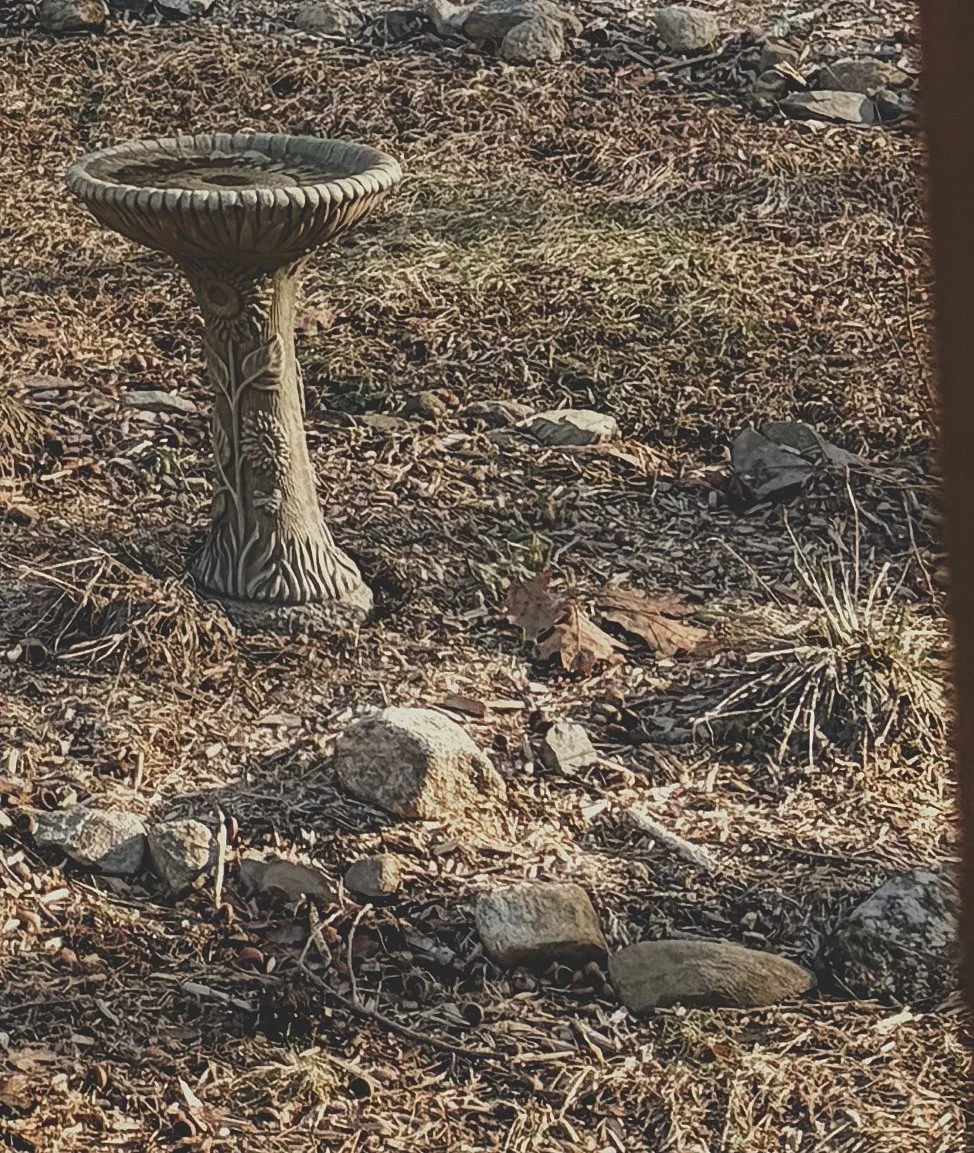
From outside my kitchen window, I see the outline of a birdbath that once stood tall. Hidden beneath a blanket of snow, only a small indentation remains — a shallow bowl suspended roughly three feet above the soil line.
What is left to see? Trees with buds just beginning to swell. The outlines of shrubs. Jagged edges of boulders dusted with dull olive-green moss. Walkways, perennials, grass, and small shrubs are swallowed whole. Just beneath, dormancy is breaking.
A few days and nights later, it becomes clear where the cold pockets settle — the first shift. Snow still piled high where the warming sun just misses. Stark white drifts beside muddy footprints reveal the once-level walkways traveled barefoot in the daze of what now feels like a summer dream. Perennials begin to show themselves, seedheads left standing from the season before. Emergence.
I begin mentally editing and moving, scheming and imagining. With every glance out the kitchen window, every tiptoe peek over the back porch lattice, new ideas — and should’s and could’s — flood my mind. If only transplanting and creating new beds were as easy as my imagination makes them. The songs of chickadees pull me gently out of my transplanting trance.
Nestled in the nook of a ledge, my gardens sit only a few steps from the back door. Boulders around a fire pit accent the topography of the land, framed within stone walls once arranged with care and still anchored by a pair of strong, majestic oaks.
Between my gardens and the stone wall, however, brambles, barberry, burning bush, and invasive honeysuckle have taken hold. Spring after spring, I take my loppers and remove what I can, tossing branches into the fire pit to burn, pulling smaller roots by hand. By May, it is as if no effort had ever been made.
Sigh. Disappointment. Defeat.
I imagine instead tufts of grass and scattered fruit trees along this ledge — a hillside orchard. Spring blossoms of peach, plum, and apple. Summer wildflowers nodding in sunny pockets while mossy boulders are softened by native shade plantings and drifts of fern guiding the eye upward to the oaks above. In fall, sunrise filtering through lingering leaves creates a mosaic backdrop. In winter, a refuge for wildlife beneath rolling blankets of snow.
In only a few weeks, my days will fill with pruning, cutting back, raking, and edging gardens for clients across the county. By the time I return home, little energy remains beyond wandering my own beds, tending lightly, keeping things minimally weeded, watered, and alive for simple enjoyment.
A shoemaker’s tale.
And so the invasive-filled ledge remains, while the vision of my hillside orchard grows faint.
All the more reason to start now, I tell myself. If I had it my way, my gardens would already be weeded, edged, composted, transplanted, deadheaded, pruned, and wrapped neatly with a fall cleanup — a tidy season’s-end bow by the first of April. Only then could I begin the real work, finally tackling the ledge and creating the space I have always imagined.
Why rush, the peony shoots and sedum crowns seem to say.
Tulips pushing through the soil remind me their season is brief — why would I skip their spring display? What of autumn, when bulb after bulb was planted in quiet preparation? Roses ask how I could think of the season’s end when their long performance has yet to begin. We have not even leafed out.
A humbling reminder of time, cycles, and seasons — and all there is to miss.
So I wait.
I crumple the to-do list. At least at home, these gardens are a place to stroll and tend with ease. Restraint.
I do what the garden asks of me in March: notice new growth, spy swelling buds, prune slowly and intentionally where it is welcomed. Certain tasks will wait for another day, another month, perhaps another season.
I trust I will be told when it is time.
