

Hamamelis Virginiana
American Witch Hazel
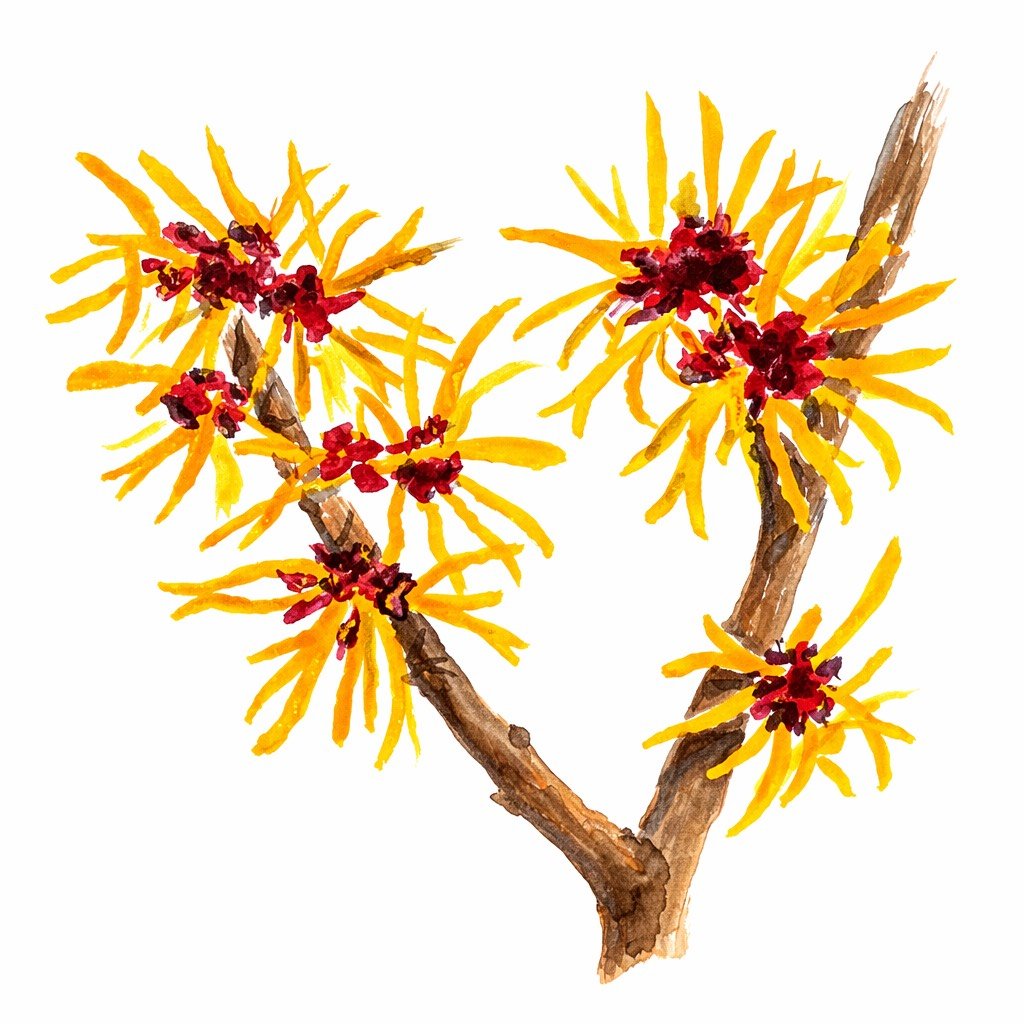
Watercolor art by Shannon Blanton
There is a quiet moment in the garden when most plants have surrendered to dormancy — leaves fallen, stems bare, color withdrawn into the soil. And then, unexpectedly, the American witch hazel begins.
Hamamelis virginiana blooms not in spring’s abundance, but in the liminal season between autumn and winter, when golden ribbons of flowers unfurl along naked branches. Each blossom clings closely to the stem, four crinkled, threadlike petals twisting like tiny sunlit streamers against the cooling air. Flowering from October through December — sometimes even later — witch hazel feels less like a bloom and more like a promise: life continuing quietly beneath the surface.
Native to woodland streams, forest margins, and shaded banks across eastern North America (Zones 4–8), American witch hazel thrives where ecosystems meet — where water, shade, and shifting seasons coexist. In the garden, it carries this same spirit, preferring woodland settings and naturalistic plant communities where it can grow with companions such as hellebore, pussy willow, spicebush, elderberry, and St. John’s wort.
A Plant of Healing and Protection
Long before modern herbalism, Indigenous peoples recognized witch hazel for its powerful medicinal qualities. Its bark and roots contain exceptionally high concentrations of tannins — natural astringent compounds known to reduce inflammation and support skin healing. Traditionally used for stings, bites, scratches, and irritation, witch hazel remains valued today for its antibacterial and soothing properties.
Folklore surrounds the plant as closely as its flowers hug the branches. Known also as snapping hazelnut, spotted alder, and winterbloom, witch hazel has long symbolized protection and adaptability. Forked branches were once carried as divining rods to locate hidden water, reinforcing the belief that the plant bridges visible and unseen worlds.
An old saying whispers:
“Carry a sprig of hamamelis to heal a broken heart.”
Whether taken literally or symbolically, the plant has come to represent emotional resilience — the ability to bloom when conditions seem least favorable.
Form & Seasonal Beauty
American witch hazel grows as a large shrub or small specimen tree, typically reaching 8–15 feet in height and width. Its branching habit is loose and open, lending a natural softness ideal for screening hedges or woodland edges rather than formal structure.
Through the growing season, oval to obovate leaves — medium to deep green and up to six inches long — create a calm, textural canopy. Margins are gently dentate to wavy, catching light and movement in shaded gardens. As autumn arrives, foliage transforms into warm shades of yellow and red, often overlapping with the first emergence of flowers — a rare moment when fall color and bloom coexist.
After leaf drop, the flowers become even more striking, glowing against bare architecture while offering late-season nectar to beneficial pollinators when few other resources remain.
In the Garden
Despite its mystical reputation, witch hazel is remarkably easy to grow. It is a low-maintenance, multi-season plant that rewards patience rather than constant intervention.
Ideal conditions include:
Partial shade to dappled woodland light
Moist, well-drained soil
Naturalistic or ecological planting schemes
Space to develop its graceful, informal form
Used as a specimen tree, screening hedge, or anchor within a woodland garden, it provides structure without heaviness — a presence that feels both grounded and quietly wild.
A Seasonal Messenger
American witch hazel teaches a different rhythm of beauty. It does not compete with summer’s exuberance or spring’s spectacle. Instead, it blooms when the garden grows introspective — reminding us that transformation often happens in quieter seasons.
Where many plants signal beginnings, witch hazel honors transition.
It flowers at the threshold — between endings and renewal — carrying light into winter and asking us to look closer when we least expect wonder.
